
LVMH and Bernard Arnault: Building a Modern Luxury Empire
LVMH did not become the world’s most influential luxury group by accident. Its scale is the result of deliberate portfolio choices, tight control over brand codes, and a financial playbook that rewards long-term consistency rather than seasonal hype. Bernard Arnault’s role sits at the centre of that story: he combined deal-making discipline with a clear view of how luxury demand behaves across cycles. By 2026, the group’s model is easier to recognise—multiple maisons, each with its own identity, supported by shared capabilities in sourcing, retail, and global execution.
How Arnault Took Control and Set the Rules
Arnault entered luxury through the 1984 acquisition of the troubled Boussac group, keeping Christian Dior as the strategic prize and selling off other assets to rebuild value. That move mattered because it gave him an anchor brand with deep heritage and pricing power—exactly the type of asset that can carry long cycles of investment. The key lesson was not simply “buy famous names”, but acquire control, stabilise operations quickly, and protect the brand’s long-term equity even when short-term cuts are unpopular.
The decisive chapter came with the late-1980s battle for LVMH control. After the merger that created LVMH, Arnault used a combination of minority positions, alliances, and governance pressure to secure leadership. This early episode shaped the group’s DNA: the centre sets financial discipline and strategic direction, while creative leadership is expected to work within well-defined brand boundaries. In practice, that balance is why LVMH can run very different houses under one roof without turning them into look-alikes.
By the 1990s and 2000s, the strategy became repeatable. LVMH focused on acquiring maisons where it could strengthen distribution, expand categories, and professionalise management without diluting identity. Arnault’s approach also leaned on patience: investments in retail networks, supply chains, and talent often take years to show up in margins, but they build resilience when demand slows.
The Core Playbook: Control, Cash Flow, and Creative Autonomy
First, LVMH tends to prefer control or decisive influence rather than loose partnerships. In luxury, control is not just about financial consolidation; it means guarding product quality, store experience, client data, and pricing architecture. This is especially visible in fashion and leather goods, where scarcity and distribution discipline can matter as much as design. The group’s willingness to invest heavily in flagships, workshops, and training is easier when governance is centralised.
Second, the model is built around cash generation that can fund the next decade rather than the next quarter. When LVMH reports strong free cash flow, it is not a vanity metric; it underwrites selective acquisitions, store upgrades, and marketing that does not depend on short credit cycles. That financial base helps explain why the group can keep investing even during softer demand, while smaller players are forced to cut back.
Third, LVMH gives creative leaders room—within guardrails. The maison remains the unit of meaning: its archives, codes, and client expectations are treated as assets. Changing a creative director is handled like a strategic reset, but the brand’s commercial engine (retail operations, merchandising discipline, production planning) keeps running. That separation—creative rhythm on one side, operational cadence on the other—is one reason the group can absorb transitions without losing consistency.
The Portfolio: Why These Brands Fit Together
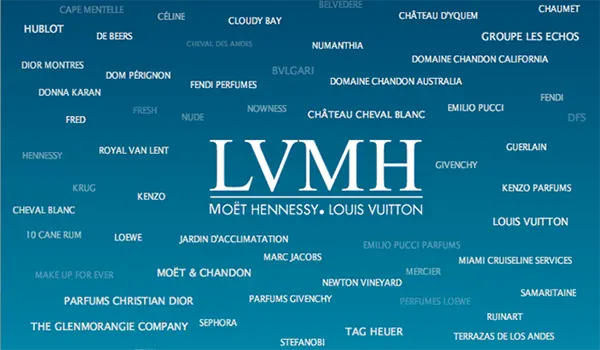
LVMH’s strength is not only the fame of its biggest names, but the logic of its mix. Fashion and leather goods deliver prestige and high margins; wines and spirits provide heritage and global distribution power; perfumes and cosmetics offer scale and entry points for aspirational clients; watches and jewellery diversify into categories with different demand curves; selective retailing builds direct relationships through stores and curated environments. The mix reduces dependence on any single trend and allows internal learning across categories.
Flagship brands such as Louis Vuitton and Dior act as the group’s cultural and financial engines, but the supporting cast matters: houses like Celine, Loewe, Givenchy, Fendi, and others help LVMH capture different aesthetics, geographies, and client profiles. In watches and jewellery, brands like Bulgari and Tiffany & Co. broaden the group’s reach into gifting and high jewellery, where client behaviour often holds up differently during downturns. Meanwhile, Sephora anchors selective retailing by combining scale with data-driven merchandising and strong store execution.
The portfolio also includes assets that look less glamorous but are strategically powerful: retail locations, logistics capabilities, and long-term supplier relationships. These are advantages that competitors cannot copy quickly. Over time, LVMH has also shown it can prune or rethink parts of the portfolio when the strategic fit weakens, which is a reminder that the group is managed as an evolving set of businesses, not a museum of famous names.
Distribution as a Competitive Weapon
Luxury is often described as “brand storytelling”, but distribution is where the story becomes measurable. LVMH invests in prime retail, store design, and staff training because the in-person experience still drives high-value client relationships. That matters even in a digital era: for top clients, service and access are part of the product. A well-run boutique is a long-term asset that protects pricing power.
Selective distribution is also a way to defend brand equity. Limiting discount exposure, controlling product drops, and managing waiting lists are not merely tactics; they are structural choices that shape how clients perceive value. LVMH can enforce these choices because it operates at scale and can absorb the cost of saying “no” to short-term volume. Smaller competitors often cannot.
Finally, the group uses its retail footprint to learn faster. Store data, clienteling practices, and regional performance trends feed back into product planning and inventory decisions. In practice, this becomes a feedback loop: strong execution in stores improves client retention, which makes demand more predictable, which improves supply planning, which reduces forced markdowns. That loop is one of the quiet reasons the group can defend margins over time.
Performance and Risks in the 2026 Context
By 2026, LVMH is still the benchmark for scale in luxury, but the market environment is not permanently easy. The group’s own reporting has highlighted how macro conditions can shift demand by region and by category, with some segments proving more cyclical than others. This is precisely where portfolio breadth helps: a slowdown in one area can be offset by strength elsewhere, as long as the group avoids overproducing and protects pricing architecture.
Recent disclosed figures show both scale and profitability. In the group’s 2024 annual results communication, LVMH reported revenue of €84.7 billion, profit from recurring operations of €19.6 billion, and free cash flow of €10.5 billion. Those numbers help explain why the group can keep investing through weaker quarters: it has the financial capacity to play defence without abandoning long-term growth projects.
However, size creates its own risks. As luxury prices rise, some consumers resist, and the group must balance exclusivity with volume ambitions. There is also creative risk: when maisons grow, keeping products fresh without betraying core codes becomes harder. And because LVMH is so visible, reputational issues—from supply-chain scrutiny to social expectations around labour and sustainability—can escalate quickly if not managed with the same rigour as merchandising.
Succession, Governance, and the Next Phase of the Empire
Arnault’s leadership has been marked by centralised governance and a strong family influence, which raises inevitable succession questions in any discussion of 2026 and beyond. For investors and industry watchers, the practical issue is not gossip; it is whether the group can preserve its decision-making speed and brand discipline when leadership responsibilities shift. LVMH has already spent years building management depth across houses and business groups, which can reduce key-person risk, but does not eliminate it.
Another governance challenge is managing a portfolio of creative cultures. Each maison wants autonomy, yet the centre demands performance and risk control. This tension is not a flaw; it is part of the system. The groups that lose it either suffocate creativity with bureaucracy or let creativity drift into inconsistency. LVMH’s track record suggests it understands the tension, but maintaining it becomes harder as the group grows and public scrutiny intensifies.
The final question is strategic focus. Luxury demand is shifting: clients are more informed, more sensitive to authenticity, and more willing to punish brands that feel generic. For LVMH, the sustainable path is not endless expansion for its own sake, but disciplined growth that protects brand meaning—product quality, client service, and a coherent identity. If the group keeps those fundamentals intact, its “empire” remains less a slogan and more a durable business model.